
Listen to Australian and world news, and follow trending topics with SBS News Podcasts.
TRANSCRIPT
The United States is preparing to extend a naval blockade of Iran’s ports, aimed at cutting off oil exports and restricting shipping.
President Donald Trump is betting economic pressure can force Tehran back to the negotiating table, with the blockade already being enforced in parts.
"Well, the blockade is genius, okay? The blockade has been 100% foolproof. It shows how good our navy is, I can tell you that. Nobody's going to play games... Now they have to cry uncle. That's all they have to do. Just say, “we give up.”
Iran’s Foreign Minister Abbas Araghchi has described the blockade as an act of war, warning Tehran is preparing to counter it, pointing to alternative routes including land corridors through neighbouring countries like Pakistan.
The Pentagon’s acting comptroller Jules Hurst has given Congress the first official estimate, around 25 billion US dollars, with most of the spending on munitions and operations.
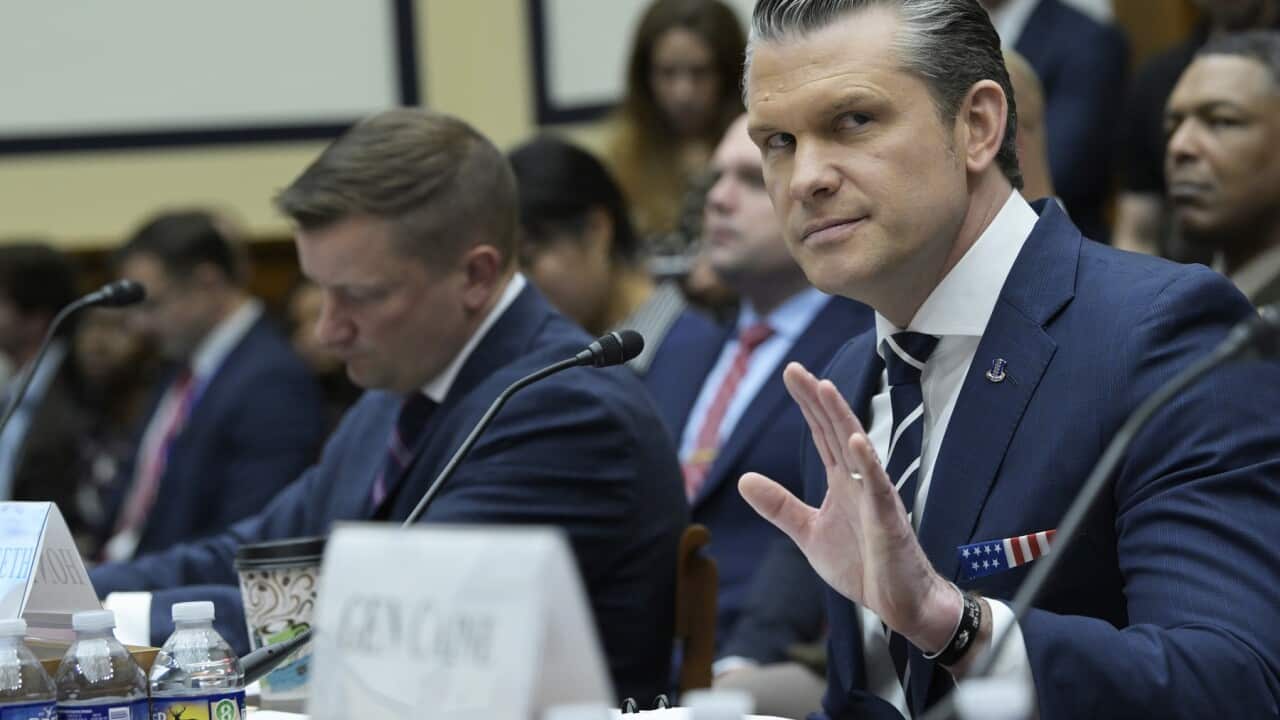
At a Congressional hearing in Washington DC, California Democrat Ro Khanna says the war has driven up the cost of gas and food.
"RO KHANNA: “Do you know how much it will cost Americans in terms of their increased cost in gas and food over the next year because of the Iran war?”
HEGSETH: “I would simply ask you what the cost is of an Iranian nuclear bomb."
KHANNA: "I'm going to give you that."
HEGSETH: "I would simply ask you what the– you're playing gotcha questions about domestic things. I'm not–"
KHANNA “You're asking– you're saying it's a gotcha question to ask what it's going to be in terms of the increase."
HEGSETH: "Why won't you answer what it cost to prevent Iran from getting a nuclear bomb?
HEGSETH: What would it cost? What would you pay to ensure Iran doesn't get a nuclear bomb? Do you? What would you pay?"
Congressman John Garamendi has also taken Secretary of Defence Pete Hegseth to task over the expenditure, calling into question whether the conflict has achieved anything.
"Secretary Hegseth, you have been lying to the American public about this war from day one, and so has the president. You have misled the public about why we are at war. You and the president have offered ever-changing reasons for this war. You've misled the public about the progress of the war. While the military has executed this war with tactical success, the strategy has been an astounding incompetence."
As the US wages economic warfare on Iran, Mr Garamendi says America’s own economy is also coming under pressure from the President’s actions.
“This war of choice is a political and economic disaster at every level. Despite the president's promise to lower the cost of living, gas prices are up 40 per cent and inflation is soaring - so much for lowering the cost of living. The president has got himself and America, stuck in the quagmire of another war in the Middle East. He's desperately trying to extricate himself from his own mistakes.”
US Defence Secretary Pete Hegseth strongly rejects that criticism, and insists the campaign has been a military success.
“Don't say I support the troops on one hand, and then a two-month mission is a quagmire. That's a false equivalation. Who are you cheering for here? Who are you pulling for? ... You sit there and go on TV for your clickbait about quagmires. It undermines the mission. Your your your hatred for President Trump blinds– blinds you to the truth of the success of this mission and the historic stakes that the president is addressing, which the American people support.”
The argument then turned to whether battlefield success matters if Iran can still influence global shipping.
Congressman Seth Moulton pressed Mr Hegseth on that point.
MOULTON: “How is this war going? Do you think we're winning?”
HEGSETH: “Militarily on the battlefield? It's been an astounding military success."
MOULTON: "No. But are we winning the war?"
HEGSETH: "Absolutely."
MOULTON: "Okay. So do you call Iran closing the Strait of Hormuz winning?"
HEGSETH: "Well, I would say the blockade that we hold that doesn't allow anything to come in or out of Iranian ports."
MOULTON: "Okay, so we've blockaded their blockade. They blockaded us, and then we blockaded their blockade. That's like saying tag, you're it. Or, you know, if President Madison has said, well, the British just burned down Washington, but don't worry, we're going to burn it down as well.”
At the centre of the conflict remains Iran’s nuclear programme.
The United States says there will be no deal unless Tehran abandons any path to a nuclear weapon.
Iran maintains its programme is peaceful.
There are also signs of diplomatic manoeuvring behind the scenes.
President Donald Trump says Vladimir Putin has offered to help manage Iran’s enriched uranium as part of a potential deal.
"He told me he'd like to be involved with the enrichment if we, if he can help us get it. I said, I'd much rather have you be involved with ending the war with Ukraine. To me, that would be more important, because we've got we're going to have that look. We're not going to let Iran have a nuclear weapon. They're not going to have a nuclear weapon. They know it, and just about everybody else does. And so we talked about that a little bit."
Under the 2015 deal, Iran shipped most of its enriched uranium out of the country, including to Russia, to limit its nuclear capability.
For now, both sides remain entrenched.
The United States is relying on a blockade and economic pressure.
Iran is signalling it can endure and respond.
With global markets already under strain, the conflict is entering a longer and more uncertain phase where the economic fallout may spread far beyond the region.